
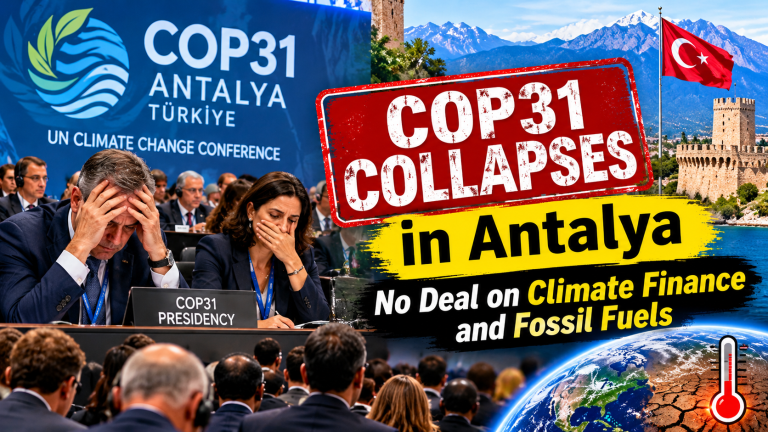

The 31st United Nations Climate Change Conference ended in failure on Sunday, after governments meeting in Antalya, Türkiye, failed to agree on an overarching deal following two weeks of negotiations and nearly two days of overtime talks. COP31 President Murat Kurum, Türkiye’s environment minister, brought the marathon session to a close after it became clear that no consensus was possible. “I understand that there is no agreement on this text. For that reason, these decisions have not been adopted,” he told delegates.
The summit, which ran for more than 49 hours beyond its scheduled finish, is now the longest-running UN climate conference on record. It is also the first major breakdown of the annual talks since the failed COP15 summit in Copenhagen in 2009, raising fresh questions about whether the process can still deliver the agreements the climate crisis demands.
The Two Words That Broke the Deal
At the heart of the collapse was a familiar dispute: fossil fuels. The first draft of the summit’s cover decision — the overarching agreement known as the “Antalya Pact” — called for “the immediate transition away from fossil fuels in energy systems”. But every mention of fossil fuels was stripped out of subsequent drafts, despite a push by more than 100 countries to keep the language in.
The divide proved impossible to bridge. On one side stood a coalition of climate-vulnerable nations and countries pushing for a stronger commitment to move away from coal, oil and gas. On the other stood oil-producing states and economies heavily dependent on fossil fuel exports. Russia, China and Arab countries backed the weakened text, but the European Union formally objected, saying it failed to “meet the moment” and risked widening the gap between climate promises and real-world action.
Panama, Vanuatu and the Marshall Islands also objected, and the group of least developed countries announced during the closing plenary that they were rejecting the text. The draft also dropped a push by developing nations for a $120 billion climate finance goal, and a proposed 35 percent electrification target was torpedoed with the rest of the pact.
“Deeply Disappointed”
UN Secretary-General António Guterres said he was “deeply disappointed” that governments had failed to reach consensus, but stressed that the outcome did not change the reality of the crisis. “The take-home message from COP31 is clear: the world must do much more to confront the climate crisis — and it must do it now,” he said, adding that there remains “no ambiguity in the science”.
Chris Bowen, Australia’s climate minister and the summit’s negotiations chair, called the result “very disappointing”, while pointing to some progress outside the main deal, including a pledge by more than 90 countries to speed up the electrification of their economies. Delegates also warned against “mistaking the drama of negotiations for impact”, describing the final draft as “the lowest common denominator”.
The talks were further strained by a dispute over the work of the Intergovernmental Panel on Climate Change, the UN’s climate science body, and by the absence of the United States, which under President Donald Trump has pulled out of international climate action. With global warming now on course to exceed the 1.5°C threshold set by the Paris Agreement, the failure in Antalya leaves the world with no new collective plan to close the gap.
What Happens Next
Attention now shifts to COP32, to be held in Addis Ababa, Ethiopia, where governments will face the same unanswered questions: how fast the world moves away from fossil fuels, and how climate finance reaches the developing countries already suffering the worst impacts. For the small island states and least developed countries that rejected the Antalya text, the message is that a weak deal is worse than no deal at all. For everyone else, COP31 stands as a warning that the climate process itself may be running out of time.
Sources: UN News; CNN; Le Monde; NHK World; The Daily Star.

0 Comments