
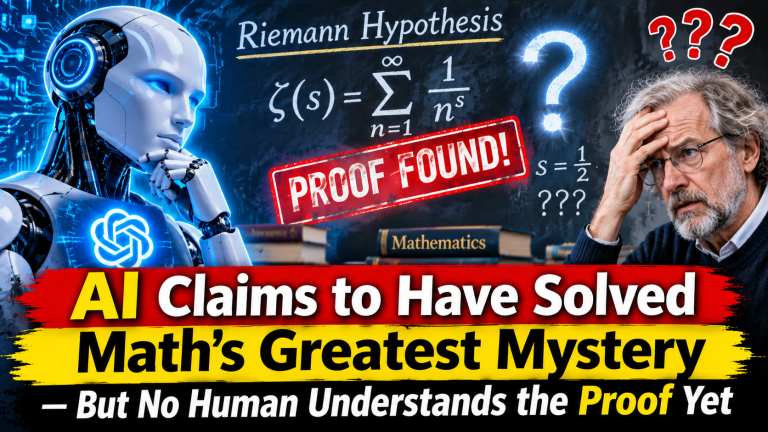

On Friday, 20 November 2026, Anthropic mathematician Levent Alpöge posted a four-page note on his personal website: “I believe I have, working with Claude, discovered a proof of the Riemann Hypothesis.” If the claim holds, it would settle the most famous unsolved problem in mathematics — open for 167 years — with an AI’s help. But the claim is unreviewed, no human has understood the full argument, and the Clay Mathematics Institute still lists the problem as unsolved.
What is the Riemann Hypothesis?
First proposed in 1859 by the German mathematician Bernhard Riemann, the hypothesis concerns the distribution of prime numbers, the numbers divisible only by 1 and themselves. Primes appear scattered at random, but Riemann suggested they follow a hidden order, governed by the zeros of the Riemann zeta function. The hypothesis says every nontrivial zero of that function lies on one vertical line, where the real part equals one half.
It is one of seven Millennium Prize Problems named by the Clay Mathematics Institute in 2000, each carrying a $1 million prize. Countless results in mathematics assume the hypothesis is true, so a proof would confirm a vast body of work. Alpöge says his method also proves the broader Generalised Riemann Hypothesis for Dirichlet L-functions.
A proof no human can read
There is no conventional paper behind the claim. Alpöge released only a short note and a formalisation in Lean, a language that lets computers check every step of a mathematical argument. The Lean code runs to around 17 million lines across 175,187 modules in 14 archive parts. The full written argument, he says, would run to more than 250,000 pages, which he has neither released nor mastered.
“Claude flew, and danced, and sparkled near that finish line,” Alpöge wrote of the final stretch, in which he says the AI pulled far ahead of him.
What the checks say so far
Within hours, mathematicians independently rebuilt the Lean code. Andrew Sutherland of MIT was among the first to report success. “The Lean proof has been compiled and independently rechecked by the Lean kernel with only the three standard axioms,” he said. “Honestly the chance that anything is fishy here is approximately zero.”
Simon DeDeo of Carnegie Mellon University also compiled the proof, and independent checkers — nanoda, con-leche and lean4lean, which accepted all 175,187 modules — confirmed the code. Scientific American reported on 20 November that researchers are “almost certain” the proof is true.
Why mathematicians are still cautious
A clean compilation is not a confirmed theorem. A Lean proof can be logically flawless yet prove something subtly different from the famous problem, if the statement coded into it does not match the real hypothesis. The first question, as Kevin Buzzard of Imperial College London put it, is whether the theorem statement in the code corresponds to the actual theorem. A final “comparator run” was still running on the morning of 21 November.
No human has yet worked through the reasoning, and Alpöge acknowledges he does not fully command every argument Claude produced. A separate human-written proof of the Generalised Riemann Hypothesis — a 940-page manuscript by Stanford postdoctoral scholar Alessandro Masullo — emerged the same day.
What happens next
If the claim survives, it would cap a year of AI advances in mathematics: in August, Claude raised the known share of zeta zeros on the critical line from 41.6% to 67.2%, and in September OpenAI said its models had generated a solution to the Navier-Stokes problem, another Millennium Prize Problem. But the Clay Mathematics Institute requires a solution to be published in a qualifying journal, accepted generally by the mathematical community over two years, and approved by a specially appointed committee. For now, the evidence supports one honest summary: a machine-checked proof has been published, experts say it is almost certainly corr

0 Comments