
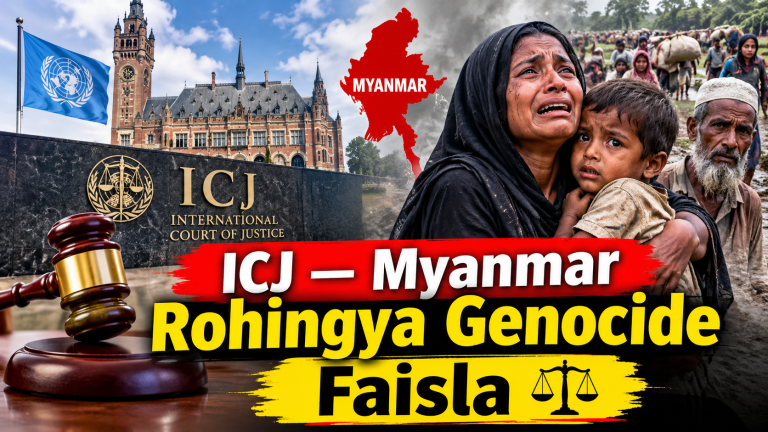

THE HAGUE — The International Court of Justice (ICJ) ruled on Thursday, November 19, 2026, that Myanmar committed genocide against the Rohingya Muslim minority during its brutal military crackdown in 2017, in the first ruling of its kind in the court’s 80-year history.
In a 9-6 decision, the court’s 15 judges found that Myanmar’s security forces acted with the intention to destroy a substantial part of the Rohingya population in northern Rakhine State, in violation of the 1948 Genocide Convention. It is the first time the ICJ has found a state responsible for genocide — and only the fourth time since the Holocaust that an international court has found the crime was committed.
ICJ President Yuji Iwasawa read out the 191-page judgment over nearly three hours at the Peace Palace in The Hague, the court’s second-longest ruling ever. The case was brought by The Gambia in November 2019 under the Genocide Convention, which allows any member state to take another to court over a breach.
The court found that Myanmar’s security forces, during “clearance operations” in 2016 and 2017, intentionally committed the genocidal acts of killing, causing serious bodily or mental harm, and imposing measures intended to prevent births among the Rohingya. Evidence showed the forces killed at least 10,000 Rohingya, committed widespread sexual violence and extreme violence against children, burned villages and attacked Rohingya as they fled toward Bangladesh.
More than 730,000 Rohingya fled to neighbouring Bangladesh during the crackdown, most of them still living in vast refugee camps in Cox’s Bazar. The judges said the scale and methods of the violence went beyond any military necessity and that the “only reasonable inference” was a genocidal intent to destroy a substantial part of the Rohingya population. The court also found Myanmar had failed to prevent genocide and punish those responsible.

What the court ordered
The ruling also orders Myanmar to repair the damage. Myanmar must immediately stop any acts that violate the Genocide Convention, investigate all persons reasonably suspected of genocidal acts and, if warranted, prosecute and punish them. It must also give assurances and guarantees that the crime will not be repeated.
On restitution, the court ordered Myanmar to allow and facilitate the safe, voluntary and dignified return of Rohingya refugees, to return or replace in kind the property they lost, to help search for the missing and ensure proper burials, and to provide physical and psychological rehabilitation for survivors.
The Rohingya are entitled to adequate compensation, the court said, but it did not set an amount; that question will be decided in a later phase. Myanmar must send the court a report within two years — by November 2028 — on the restitution measures it has adopted and the compensation it proposes. The court did not order Myanmar to restore citizenship to the Rohingya, most of whom were left stateless by a 1982 law.
A final ruling — but no police to enforce it
The judgment is final and binding, and it cannot be appealed. But the ICJ has no enforcement arm of its own, and it remains unclear whether Myanmar’s military-led government will comply. The Gambia could now take the case to the United Nations Security Council and ask it to act.
UN Secretary-General António Guterres welcomed the judgment as a “powerful recognition of the Rohingya victims of genocide”. Human Rights Watch called it a historic milestone in the Rohingya’s long quest for justice. In the refugee camps of Cox’s Bazar, Rohingya refugees gathered to follow the verdict.
Why the ruling matters beyond Myanmar
Legal experts say the judgment sets a precedent for how the 1948 Genocide Convention is applied to states accused of atrocities, and it will be studied in other cases before the court, including South Africa’s case accusing Israel of genocide in Gaza, filed in 2023. The next date is November 2028, when Myanmar’s report on its reparations plan is due.
Sources: Al Jazeera; Channel News Asia; UN News; Human Rights Watch; The Irrawaddy / Bangkok Post.

0 Comments