
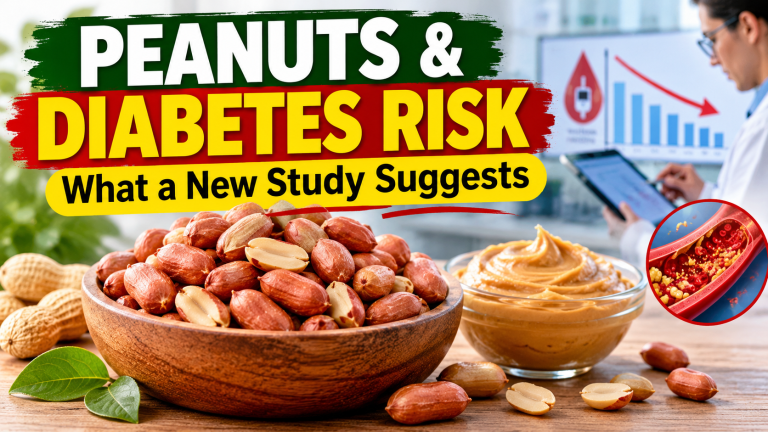

Eating peanuts could help reduce the risk of type 2 diabetes, according to a new study published in November in the American Journal of Clinical Nutrition. Researchers found that changes in blood fats linked to eating peanuts were associated with an 11% lower risk of developing the disease in a large population study — though they were quick to stress that the result shows a link, not proof that peanuts themselves prevent diabetes.
The study combined two sources of evidence. The first was the ARISTOTLE trial, a six-month randomised trial in which 63 healthy participants aged 18 to 33 ate either 25 grams of roasted peanuts with skins or 32 grams of peanut butter every day. The second was the EPIC-Potsdam cohort, a large population study in which the researchers could track how the same peanut-related patterns in blood fats lined up with who went on to develop type 2 diabetes.
What the Researchers Found
The key lay in a group of fats in the blood called very long-chain saturated fatty acids, or VLCSFAs. Eating peanuts shifted the pattern of these fats in the participants’ blood, and in the larger population study, people whose blood showed that same peanut-related pattern had an 11% lower risk of type 2 diabetes.
The researchers also found that body weight explained a large part of the link — around 89% of it, in their analysis — and they concluded that the reduced risk was “partly through BMI”. In other words, peanuts may be linked to lower diabetes risk partly because of how they fit into a person’s weight and overall diet, rather than through a direct effect of the nuts alone.
What the Experts Say
Doctors not involved in the study urged caution about reading too much into the headline number. Dr Sirisha Vadali, a cardiologist and program director of HonorHealth’s Cardiometabolic Program, told Medical News Today that the finding is “an association from a population study, not proof that peanuts prevent diabetes”, and pointed out that the trial which identified the blood-fat changes was small — just 63 young, healthy adults.
Dr Tiffany Marie Hendricks, a physician and metabolic health educator, added that the authors themselves describe the work as “hypothesis generating” — a starting point for further research, not a final answer. Both experts agreed that the study is a useful clue, but not a reason to start eating large amounts of peanuts on their own.
What It Means for Your Plate
Peanuts are nutritious — they provide protein, fibre and healthy fats — but they are also calorie-dense, and that matters. As Dr Vadali put it, the goal is to swap peanuts in for something less nutritious, like chips, crackers or a pastry, “not to add them on top of everything else”. A small daily handful, roughly the 25 grams used in the trial, is a sensible portion.
It is also worth noting who paid for the research: the study was funded by the Peanut Institute Foundation. That does not make the findings wrong, but it is a detail readers should know, and the researchers disclosed it openly.
For now, the honest summary is this: people who eat peanuts regularly tend to show blood-fat patterns linked to a lower risk of type 2 diabetes, and the link is partly explained by body weight. It is a promising lead, and one more reason to choose nuts over junk food — but it is not a prescription, and it is not proof that a handful of peanuts a day will keep diabetes away.
Sources: Medical News Today; American Journal of Clinical Nutrition.

0 Comments