
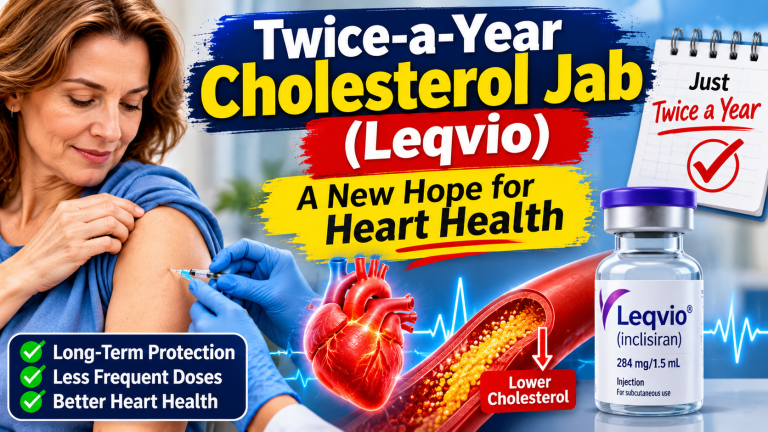

A cholesterol-lowering injection given just twice a year has reduced the risk of heart attacks and strokes in people with established heart disease, according to landmark trial results announced by Novartis on Monday, November 23, 2026. The Phase III ORION-4 trial met its primary endpoint, showing a statistically significant and clinically meaningful reduction in major adverse cardiovascular events when the drug, Leqvio (inclisiran), was added to standard cholesterol-lowering treatment.
The result is the first cardiovascular outcomes evidence for a small interfering RNA (siRNA) therapy — a class of medicine that works by switching off a gene involved in cholesterol production. Until now, Leqvio was known to lower LDL cholesterol, often called “bad” cholesterol, by around 50 percent. What doctors did not have was proof that this actually prevented heart attacks and strokes. ORION-4 provides that missing evidence.

How the Trial Worked
ORION-4 is a large, randomised, double-blind, placebo-controlled trial led by the University of Oxford in collaboration with the TIMI Study Group, and co-sponsored by the University of Oxford and Novartis. Around 15,000 men aged 40 and over and women aged 55 and over with established atherosclerotic cardiovascular disease — meaning they had already had a heart attack or stroke, or an operation for blocked arteries — took part at around 180 clinics in the UK and the United States over a planned median follow-up of about five years.
Participants received either inclisiran or a placebo by injection under the skin on the first day, again at three months, and then every six months — just two injections a year after the initial doses. Researchers measured major adverse cardiovascular events, a composite of coronary heart disease death, heart attack, fatal or non-fatal stroke, and urgent procedures to reopen blocked heart arteries.
Professor Louise Bowman of Oxford Population Health, the trial’s lead investigator, said: “ORION-4 provides evidence that inclisiran is well tolerated and can reduce the risk of major cardiovascular events in people with established vascular disease.” Novartis described the trial as a meaningful advance, demonstrating for the first time the potential to significantly reduce cardiovascular risk with a twice-yearly therapy.
What We Still Don’t Know
Novartis has so far released only headline, or “topline”, results — it has not disclosed the exact size of the risk reduction, and the full figures have not yet been published in a peer-reviewed journal. The company says complete results are planned for publication in the first half of 2027, and a second trial, VICTORION-2 PREVENT, is also expected to report in 2027. Together, the two trials have enrolled more than 33,000 participants, forming one of the largest cardiovascular outcomes programmes of its kind.
That caution matters. Earlier, smaller studies of inclisiran had mixed findings on hard outcomes: a pooled analysis of 3,655 patients reported lower rates of combined cardiovascular events, while a meta-analysis of 3,713 patients found heart attack risk fell by about a third but no clear effect on stroke. ORION-4, designed specifically to answer the question, is far larger and longer than those earlier studies — which is why cardiologists have been waiting for it.
What It Could Mean for Patients
If the full results confirm the headline finding, inclisiran could become a much more widely used option for people at high risk of a second heart attack or stroke, particularly those who struggle with daily tablets. A twice-yearly injection given in a clinic removes the problem of forgetting pills — one of the biggest reasons cholesterol treatment fails in real life. For now, patients should not change their treatment on the basis of a press announcement: the drug is already approved for lowering cholesterol, but doctors will want to see the detailed results before changing who receives it and why.
Sources: Novartis (via GlobeNewswire); Seeking Alpha; ClinicalTrials.gov (trial NCT03705234); HealthRX.

0 Comments